This BLOG | WebSite | About Us | TN|Rumble

Quick Join Bike Walk Tennesee via Paypal


Showing posts with label Bike lanes. Show all posts

Monday, July 23, 2012

Report - Physical inactivity causes 10% of all worldwide deaths

CNN reports that a report series in The Lancet notes that physical inactivity is just as deadly as smoking or obesity. (Obviously the latter and physical inactivity are also linked.) If inactivity rates drop by 10-20%, then anything between one half to 1.3 million lives can be saved annually worldwide. The authors consider such inactivity to be equivalent to a pandemic.

In the third article of the series, Gregory Heath of the University of Tennessee wrote that "Because even moderate physical activity such as walking and cycling can have substantial health benefits, understanding strategies that can increase these behaviors in different regions and cultures has become a public health priority," and that improvements in mass transit and the walking and cycling environment can produce real benefits. As has been previously mentioned, we have engineered much physical activity out of our lives, but we can reverse the trend. Support for improved cycling and walking infrastructure in our communities have the following beneficial effects.

  1. Improved health,
  2. Decreased cost - I had mentioned that a car cost $11-$22 per day
  3. Improved environment,
  4. Decreased congestion,
  5. Improved community, with people being more neighborly and social,
  6. and Decreased dependence on foreign oil.
And all of these benefits take place at the same time making such investments a wise use of resources, provided that the money allocated for such is spent wisely.

Thursday, June 7, 2012

Proposed Concord Road (SR-332) Project

The Farragut Press Enterprise is reporting that the proposal to widen Concord Rd (west end of SR-332) from Turkey Creek Rd to Northshore Dr is running into opposition. The road would go from two lanes to five, with bike lanes and a sidewalk on one side of the street. A asphalt greenway would line the other side. Opponents of the project have raised objections over the amount of land (and a home) that would have to be taken. In addition, there is the argument that development in the area has come to a standstill, and that the widened road would end at two lane Northshore Dr, which is arguably a busier road.

The west (actually north) end of the proposed project (going beyond Turkey Creek Rd) has previously been widened to include sidewalks on both sides, but no bike lanes, and has a 40 mph speed limit. The stretch in question currently has a 30 mph speed limit, but has no sidewalks, bikelanes, or parallel greenways. Many drivers exceed the 30 mph limit there. Certainly sidewalks would provide a means for people living in the area to more readily walk to the rest of town, including other neighborhoods, Kroger Marketplace, The Little Gym, and beyond. The bike lanes unfortunately would not extend past Turkey Creek Rd, although the road itself is actually quite ride friendly due to the presence of two lanes on each side.

Would going from two lanes to five (with probable higher speeds) be better or worse for cyclists? As previously mentioned, sidewalks would benefit pedestrians. Long term plans call for a greenway paralleling Northshore Dr to improve connectivity throughout the area. In this era of tightened budgets, could improvements short of going to five lanes be made that would not be so expensive and potentially disruptive?

Tuesday, August 9, 2011

The importance of contacting local officials

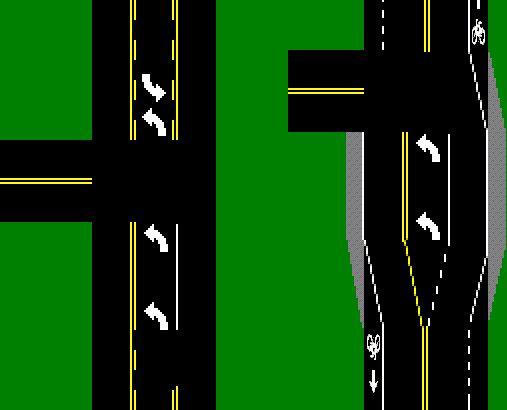
Recently, I saw that a bike lane was painted on Lovell Rd in Knox County that was to the right of a right-turn only lane as part of its widening project. Earlier, I had found that a pedestrian push signal was non-functional on Northshore Dr, also in Knox County. For the first case, I contacted Kelley Segars at the Knoxville Regional TPO (Transportation Planning Organization) about the issue. She was quickly able to make the relevant inquiries, and had the problem corrected - the bike lane was terminated before the intersection in question with a "Share the Road" sign to be erected since there is no bike lane beyond that point anyhow. In the second case, an email to engineering soon resulted in the defective signal being repaired.

Bike/Walk advocates should report cases of substandard designs and malfunctioning signals to the relevant people. Sometimes we can notice specific things before others do, and improve the bike/ped scene for all.

Monday, June 6, 2011

Universal Bike Lanes: A Way to Mass Cycling?

This study clearly shows that a multi-faceted approach to bicycle and pedestrian improvements is the Complete way to go in changing a county's auto center culture.

"Despite the fact that some parts of the country are still cycling deserts, the good news in recent years is that cycle use in Britain overall has at last started going up – albeit from a very low base compared to many of our continental neighbours. London has led the way, with its hire-bikes, super-highways, cycle maps and excellent marketing initiatives, which have more than doubled cycle use in less than 10 years. But places like Portsmouth and Leicester have also achieved a great deal with a lot less cash. They have been investing in 20mph speed limits and closing off city centre streets to all but cyclists and pedestrians. They have been running 'smarter choices' programmes like cycle training or carefully targeted social marketing programmes to promote cycling for women, children, employees, health patients and so on. All these measures are proving very effective at boosting cycle use, thereby gradually building up the political will to do the things that will really transform our car-dominated congested roads into cycle-friendly, neighbourhood-friendly streets for people and the surrounding communities." Read the Sustrans article HERE.

Wednesday, June 1, 2011

Road Repairs

Smart Growth America and Taxpayers for Common Sense have just released a report entitled Repair Priorities: Transportation spending strategies to save taxpayer dollars and improve roads. The report basically makes the point that many of the existing roads are not in good shape, and that it would be most cost-effective to repair the existing roads before they deteriorate further. However, states have a tendency to build and expand new roads before caring for existing ones. New construction means more road to maintain later on, adding to the financial burden. According to the report, Tennessee has 30% of roads that are in less than good condition. Between 2004 and 2008 though, it spent $487 million on new construction and $116 million on maintainence.

Walking and cycling facilities are frequently included in new construction, and are less likely to be added to a maintainence project. Retrofitting existing streets to make them more pedestrian and cyclist friendly is sometimes difficult to impossible, depending on traffic volumes and speeds. However, where retrofitting is possible is often where significant progress can be made at minimal cost. Road diets that take one underused lane and convert it into bidirectional bike lanes are one example; if there is substantial turning traffic, simply restriping the road to have dedicated left/right turn lanes and pockets frequently means that a three lane road can handle as much traffic as a four lane, and be safer even for cars. Narrowing existing lanes to widths of 10-11 ft (termed a lane diet) sometimes would permit the striping of bike lanes. Even if bike lanes cannot be accomodated, a cycling-friendly wide outside lane of 14-15 ft may be possible. The key point is that with maintainence that needs to be done anyway, simple reconfigurations require nearly zero construction cost. With today's tight transportation budget, such savings are crucial. Portland, OR was able to take advantage of such "low-hanging fruit" in order to obtain their network for a grand total of around $60 million.

Wednesday, May 11, 2011

Bicycling Terminology - The Right Hook


The right hook refers to a type of car/bicycle conflict that takes place at intersections. As illustrated in the figure above, a right-turning car can turn in front of a bicycle traveling straight. If the cyclist cannot avoid running into the turning vehicle on time, a crash results.

Tuesday, April 26, 2011

Bicycle facilities terminology - the infamous "door zone"

(Photograph courtesy of Wikipedia - Image is in the public domain.)
The door zone refers to the area at the side of parallel parked cars and trucks which would be intruded upon by the car door, were it to be opened. The door zone is hazardous for cyclists to ride in, since a car door often opens without warning, leaving the cyclist no opportunity to stop in time to avoid it. Bike lanes sometimes have portions that overlap the door zone. If such were the case, it would be extra hazardous for the cyclist to swerve into the car lane in order to avoid a collision, since any passing traffic would not be expecting such a maneuver. If there were no bike lane, there still may not be the expectation of such a maneuver. Worst of all is the case where the opening car door directly knocks the cyclist into passing traffic; fatalities due to such have occurred.

Saturday, April 2, 2011

NACTO Urban bikeway design guide available online

The National Association of City Transportation Officials (NACTO) has released online a design guide for the design of non-standard and creative bike facilities. The guide shows a variety of setups such as bike boulevards, bike-specific traffic signals, intersection treatments, and the like. NACTO member cities are
Atlanta
Baltimore
Boston
Chicago
Detroit
Houston
Los Angeles
Minneapolis
New York
Philadelphia
Phoenix
Portland
San Francisco
Seattle
Washington DC,
and Austin, TX is an associate member. Are there places in Tennessee that can benefit from some of their ideas?

Monday, January 31, 2011

Classes of bicycle facilities

Yesterday's blog post described the changes in Congress as well as how Rep. Duncan Hunter (R-CA-52) mentioned in an interview about how he felt cycling is more of a recreational rather than a transportation thing. (As a side note, this Rep. Hunter is the successor of long-term and probably better known Rep. Duncan Hunter.)

Yes, it is true that a good deal of cycling is done for recreational purposes. But a good deal of cycling is also done for transportation, due to its convenience and low price, in addition to the built-in exercise. One who rides for transportation gets a workout just by going where one was going anyway. A variety of facilities exist, and facilities can be classified into three classes.

Wednesday, December 8, 2010

Bridging the Gap - Must Read ABW Report

Hot off the presses this afternoon, Bridging the Gaps in Bicycling Networks: An advocate's guide to getting bikes on bridges is your first step in securing these critical links within your community's transportation network. Click here to download your copy.

Friday, November 26, 2010

Future Concord Rd expansion plans

A further development in terms of infrastructure construction in Knox County and the town of Farragut is detailed here. Basically, starting three years from now, Concord Rd will be widened from two lanes to five, with bike lanes and a sidewalk on one side and an extra wide trail on the other. The "median islands" mentioned are a recent development, in that studies have shown some downside to having a continuous center-turn lane. A new bridge will be built to feed into the roundabout at Northshore Drive. A greenway paralleling Northshore Drive will be built on its north side. (Since much of Northshore drive has few intersections, the greenway should be OK for cycling.)

For what it's worth, proposed Concord Rd expansion was previously held up as part of transportation spending rescissions. As such, it's difficult to project what the funding situation will be three years from now, which is the scheduled start of construction. To what extent traffic levels will require a five lane road is another question.

Thursday, November 25, 2010

Campbell Station Rd expansion complete

The Farragut Press Enterprise is reporting that the widening of Campbell Station Rd is complete. This stretch of road has been widened to be 5 lanes, with bike lanes and sidewalks on both sides. This project is an example of a road widening that also completed the street, in that all modes of travel are readily accommodated now. It is also located in such a way that quite a few neighborhoods have ready access to all the Farragut Schools (Primary, Intermediate, Middle, and High) in addition to the Farragut branch of the Knox County Libraries.

Putting more cyclists and pedestrians on the road is a good thing, even when there aren't special facilities for them in that drivers would tend to be more alert. One effect of bike lanes in areas is that people tend to venture beyond the areas with the lanes, putting more bikes on the road overall.

Monday, October 18, 2010

Oak Ridge Turnpike - phase I expansion complete

Oak Ridge Turnpike, one of the main thoroughfares through the city of Oak Ridge, has had a 4 mi section widened with 5 ft sidewalks and 6 ft bike lanes on both sides. The phase I widening project extended from Illinois Ave to Westover Drive. More details are available at the Oak Ridger Website. The project cost $26.1 million.

Tuesday, October 12, 2010

NYC Reclaims it's Streets from Automobiles

If New York City can create more than 200 miles of bike lanes. If New York City can begin that transition of turning their streets into places for people rather than places for personal vehicles. Just think what the rest of us can do!

Take a look at this video put together by EMBARQ. It shows what New York City has done, and it just may spark some ideas for the rest of us.

http://www.grist.org/article/2010-10-11-how-nycs-streets-are-being-reclaimed-from-the-automobile-video

Sunday, September 12, 2010

Chuck Anderton - Bike/Walk Commuter

There was an article in the August 2, 2010 edition of the Bearden West Side Shopper-News (online edition not available) about Chuck Anderton, who is an electrical engineer at KUB (Knoxville Utilities Board) in downtown Knoxville. He has "walked, run, or biked" to work for the past 42 years, and his last sick day was in 1981. His commute ranged from 1 to 7 miles each way, depending on where he lived. He bikes from April to September, where there is light both ways. The other days he tends to walk, even though it does take a while. Needless to say, he's a very healthy individual.

One of the big draws of urban living is being close to most of the things going on, and of having an easy, short commute. Interestingly, truly urban areas have bikes and cars move at roughly equal speeds which means that facilities such as bike lanes are unneeded in such areas. For instance, Gay St in downtown Knoxville is considered one of the finest places to ride.

Thursday, September 2, 2010

Reasons to support biking and walking for almost all political philosophies

With the recent article claiming that (paraphrasing) cyclists are part of a communist plot to turn the country into a third world country, I thought I would list the reasons why it makes sense from a variety of political sides to support cycling and walking. Sure, that article was extreme, but more moderate variants of such are not unheard of.

Sunday, August 22, 2010

CHEAP road diet idea


(just posted to bikeforums.net)
Wanted to get a feel for this road diet idea. Basically, there are quite a few 3/5 lane roads that have an excessive amount of two-way center turn lanes that aren't really used much; for instance, stretches of road exist that aren't full of left turning vehicles.

These stretches of road can be readily repainted to eliminate the redundant turn lane, with minimal widening around intersections where the turn lane does help and putting in bike lanes in the resultant freed space. I have illustrated the concept with a before/after diagram, and the needed widening shown in gray. So what do you all think? Does a minimal amount of road widening cost substantially less than full-scale widening?

Tuesday, August 17, 2010

Bicycle facility signs

This may be old news to most of you but it is new to me.  The 2009 Manual of Uniform Traffic Devices has bicycle facility signs nicely grouped.  Of especial joy to me was the R4 11, Bikes may use full lane sign.  I'd like to see about a thousand of these posted around Tennessee.
http://mutcd.fhwa.dot.gov/htm/2009/part9/fig9b_02_longdesc.htm
Bruce

Wednesday, July 21, 2010

Seattle Buffered Bike Lanes

Just read and submitted a comment on Seattle's latest buffered bike lane.

It's an interesting experiment; however, I wanted to bat around the idea of whether the buffer space is better placed next to the parked cars, rather than between the bike lane and motorized traffic. A buffer space next to the parked cars would basically eliminate the door zone issues otherwise present whenever there is a bike lane and parallel parking. Even if the bike lane were narrowed from 5 to 4 ft for more buffer, the avoidance of door zone issues would be a huge plus. I venture that hit from behind incidents when a bike lane is present are rare, and that the added comfort from the buffer is illusory. What do you all think?

Wednesday, May 19, 2010

Bike Lane Improvements in Rutherford County

The Murfreesboro City Council unanimously approved spending federal stimulus funds to resurface Thompson Lane at its weekly meeting Thursday night. The federal funds will also add a new bike lane.

http://murfreesboropost.com/city-council-approves-thompson-lane-improvements-cms-23028